Showing Up: What It Takes for Children in South Sudan to Attend School
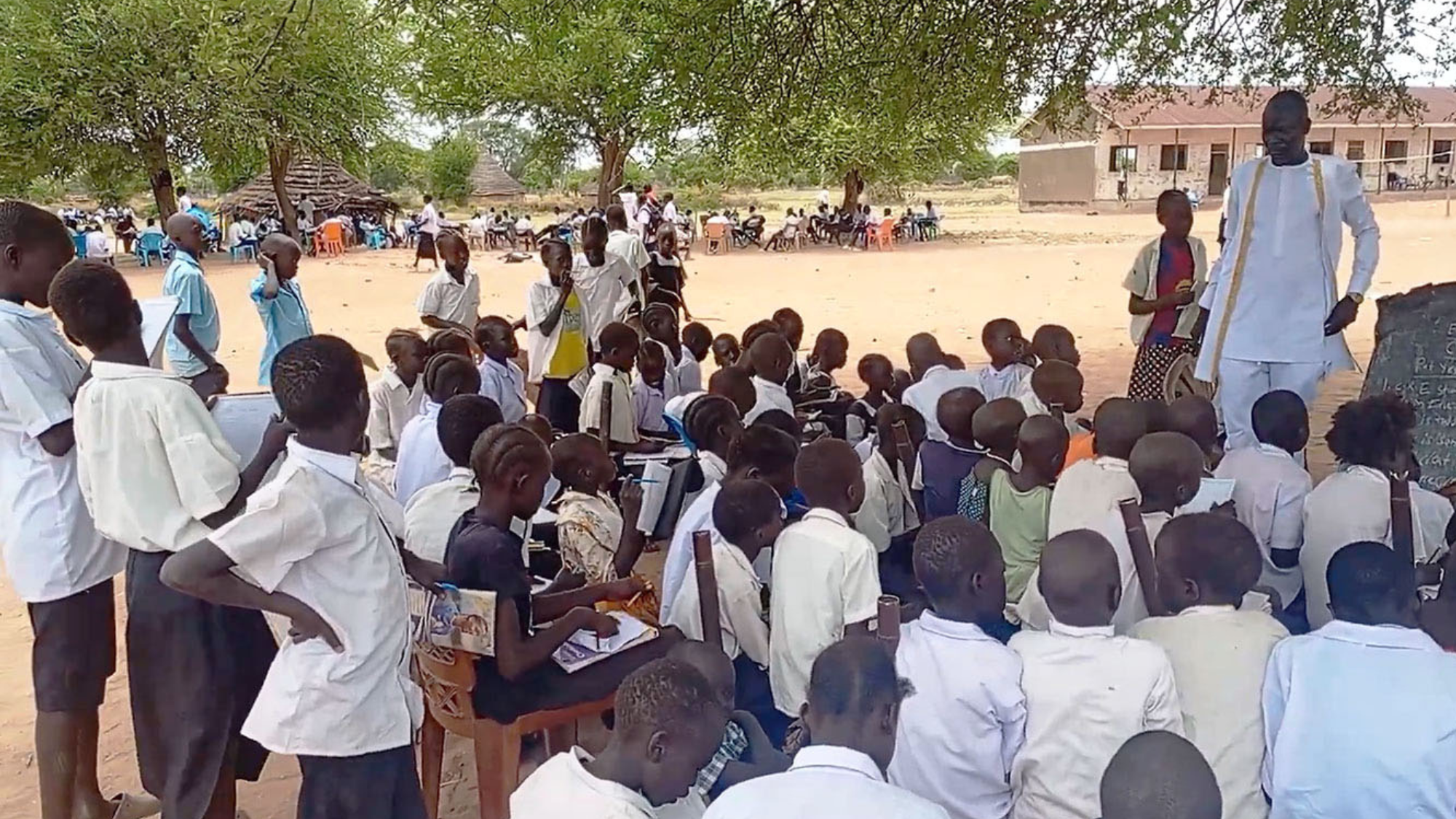
At first glance, the photo seems simple.
Children attend a class together, dressed in white uniforms, focused on the lesson in front of them. They have shown up.
It would be easy to call this resilience. In many ways, it is. Across South Sudan, children, families, and teachers continue to pursue education despite conditions that ask far too much of them.
But showing up for school should not require extraordinary resilience.
A school day begins long before a child reaches the classroom. It begins at home. It begins with whether clean water is nearby. It begins with whether someone had to walk for it that morning. It begins with whether a child is healthy enough to attend, whether a girl has a safe and private place to manage her period, whether a family has enough time, and whether the community has the basic infrastructure that allows daily life to hold together.
These are the realities we do not see in the photograph.
We do not see the morning walk to collect water.
We do not see the child staying home sick from a waterborne illness.
We do not see the girl missing class because there is no clean, private place to manage menstruation.
We do not see the family making difficult choices about time, safety, work, and education.
These are not failures of motivation, nor signs that families do not value education. They are the result of barriers that should never have existed in the first place.
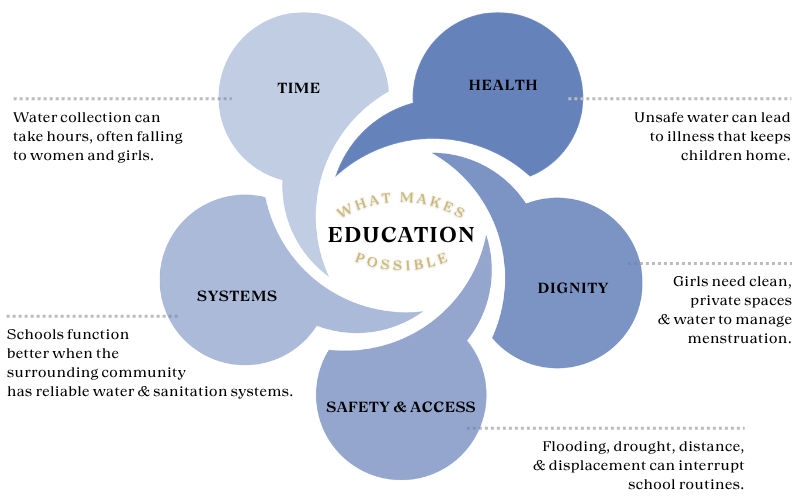
Education begins before a child reaches the classroom.
Time, health, dignity, safety, and reliable community systems all influence whether a child can attend school and learn. Access to clean water supports each of these conditions, helping remove barriers that stand in the way of education.
Water is not the only challenge children face, but it touches nearly every part of daily life.
When clean water is far away, time disappears. In many communities, collecting water can take hours, and that responsibility often falls on women and girls.
When water is unsafe, children become sick. Illness interrupts education, strains families, and deepens hardship in households already carrying heavy burdens.
When schools and communities lack reliable water and sanitation, girls face additional obstacles to attending school with dignity and confidence.
When drought, flooding, or displacement disrupt daily life, the absence of reliable water makes every challenge harder to overcome.
This is why clean water is foundational to learning.
Not because a well teaches a child to read, and not because water alone can solve the challenges facing South Sudan’s education system. It cannot. Schools also need teachers, materials, safety, family support, functioning systems, and long-term investment.
But without clean water, the path to education becomes harder, less healthy, less dignified, and less reliable.
Water does not guarantee learning. But its absence can stand in the way of it.
Water for South Sudan helps strengthen one part of that foundation by drilling and restoring wells, building water systems, and supporting sanitation infrastructure in underserved communities. We partner with communities to help sustain access through local water management committees, hygiene education, repair pathways, and long-term community ownership.
A water point does not remove every barrier. It does not end poverty or guarantee that every child will reach the classroom.
But it can change what is possible.
It can reduce the time and physical burden of collecting water. It can support health and hygiene. It can bring greater stability to daily routines. It can help girls attend school with greater dignity. And it can give families, teachers, and children more of what they need to keep showing up.
That is the story behind the photograph.
Not a story of children overcoming impossible conditions on their own, but a story about the conditions that should surround them in the first place:
Clean water. Sanitation. Health. Safety. Time. Community leadership. Systems that last.
Children across South Sudan are already showing up. Families and teachers are showing up too.
Our work is to help the systems around them show up as well.
Because a school day does not begin at school.
It begins with the conditions that make it possible for a child to arrive there.
Help Build the Conditions That Make School Possible
Your support helps communities across South Sudan access clean water, strengthen local ownership, and sustain the systems that support health, dignity, opportunity, and learning.